Dozens gather to condemn 'Big, Beautiful Bill' backed by Nebraskans in Congress
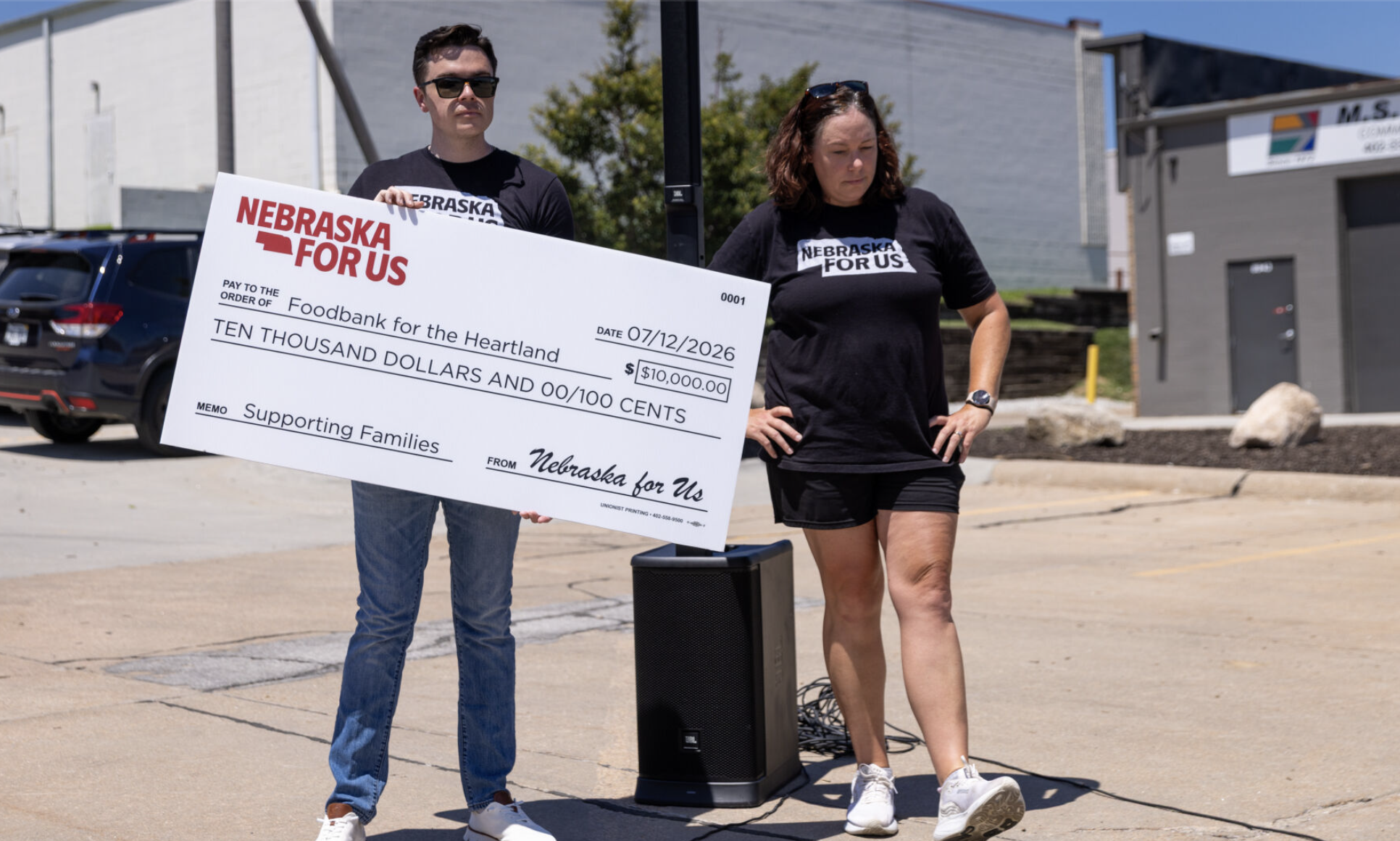
Collin Adler Ruane holds a check donated by Nebraska For Us to Food Bank for the Heartland, as he stands beside Angie Lauritsen, state director of Nebraska For Us, during a barbecue at IBEW Local 22 in Omaha on Sunday.
By Olivia Moody, Omaha World-Herald
(July 16, 2026)
Community activists gathered last weekend to criticize benefits for billionaires following the first anniversary of President Donald Trump signing the One Big Beautiful Bill Act, his signature tax and spending law.
Local political advocacy group Nebraska For Us partnered with the national Families Over Billionaires to host a Community BBQ for Food Security event on Sunday. The event aimed to draw attention to spending cuts, including reductions in the Supplemental Nutrition Assistance Program, or SNAP.
Hosted at IBEW Local 22, the event was part of a national tour by Families Over Billionaires, which began in Maine and will end in Arizona. The event drew boisterous "Pissed Off Grandmas," some who wanted to meet like-minded people and others who wanted a free meal.
Participants also raised their voices against the wealthy.
Kristin Crowell, executive director of Families Over Billionaires, chanted to the group, “When billionaires get a (tax) break, who pays?”
“We pay!” the crowd responded.
Within H.R. 1, which was passed on July 4, 2025, SNAP benefits were put under stricter regulation to reduce federal spending by $187 billion over 10 years. Some of these new provisions include clarifying that only American citizens are eligible for SNAP and requiring adults aged 55 to 64 and those with children over 14 to work a minimum of 20 hours a week to receive benefits.
From April 2025 to April 2026, Nebraska households participating in SNAP dropped 11%. Organizers noted that the need remains.
In Nebraska, 267,960 people are food insecure, according to Feeding America, a nonprofit that studies hunger rates nationally and state by state.
Angie Lauritsen, state director for Nebraska For Us, said the group planned the event to show how H.R. 1 was impacting Nebraskans and to put a spotlight on hunger in an agricultural state.
“We (are) the largest exporter of cattle within the country,” Lauritsen said. “We have an overabundance of food ... why are we not OK?”
All five members of Nebraska's congressional delegation, each of them Republicans, voted for the bill. House and Senate Republicans have been praising the bill's tax and spending cuts as helping the American economy.
Rep. Mike Flood, R-Neb., who is running for reelection, initially voted for the bill and defended his support for it during a town hall in Sarpy County on July 7.
At the town hall, Flood said H.R. 1 "protected Medicaid in a bipartisan, commonsense way."
Sen. Pete Ricketts has also defended his support for the bill. He told NTV last July that the measure included important pieces boosting national and border security. Ricketts praised the $46.5 billion proposed investment in completing the border wall system.
Lauritsen criticized the Republican bill and said rising costs are making people neglect parts of their budget.
“That's where maybe you're not making rent, maybe you're not making your house payment, maybe you're not getting your car fixed," she said. "Maybe you are not going to go to the doctor ... so you start to make these life-changing choices because you still need food,” Lauritsen said.
The weekend event donated $10,000 to the Food Bank for the Heartland, which will be used to purchase high-demand foods, such as meat and dairy products. It also provided 250 free meals to attendees, allowing each to take another meal home.
Tim Williams, government affairs and advocacy officer for the Food Bank for the Heartland, said emergency food aid is important, but SNAP provides stability for families in need. H.R. 1 added "another layer of burden onto that pantry system,” Williams said.
Lauritsen said she hopes that the Senate will pull back on some SNAP restrictions in the next farm bill, which channels funding to the program.
Crowell said voters have the power.
“I think a different kind of political movement has been building, and it's not about party politics,” Crowell said. “It's about centering real people and real experience. And I do believe that the tide will shift, and ... they're sorely out of touch with what is coming.”
Sherry Guthridge, an administrative assistant who is taking care of her three grandchildren alone, was cut off from SNAP in January. She reapplied and was denied. She has no idea why.
“I'm not an activist person,” Guthridge said. “I kind of don't know where to start, but this kind of makes me feel like maybe I could be a 'Pissed Off Grandma,' or you know, learn some more about what is being done."
Guthridge utilizes four different church food pantries a month to feed her family.
“There are more of us, but we're suffering," Guthridge said. "We're the country of more than enough. We're supposed to be this beacon and example to the rest of the world.”