Nebraska farmer groups say Trump's subsidies offer some relief but ag reforms needed
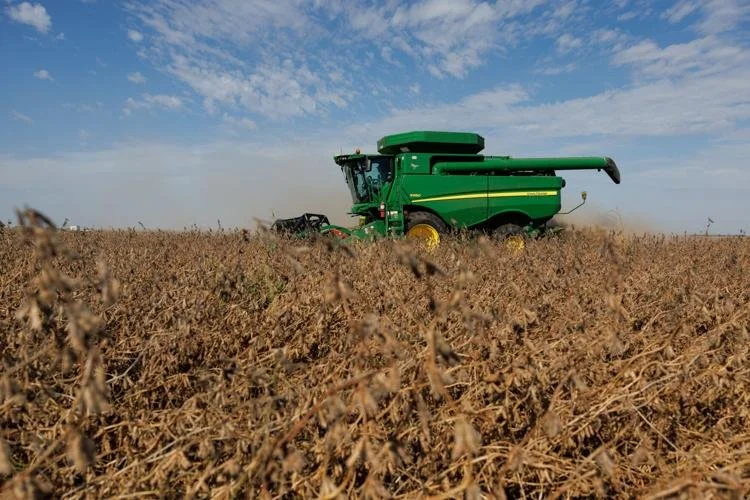
Trump plans the aid package for US farmers who have struggled to sell their crops while getting hit by rising costs. Trump's aggressive trade policies and changing tariffs have come under increasing scrutiny because of the impact on agriculture.
By Josh Reyes, Omaha World-Herald
(December 9, 2025)
John Dittrich’s family has farmed corn and soybeans for generations near Meadow Grove and Tilden, Nebraska.
The farm has weathered a series of bad years and is in shape to weather more amid uncertainty from the United States’ trade conflict with China, the world’s biggest buyer of soybeans.
Dittrich said any farmer hates to accept help from the government, but with the market as it stands, “a farmer has no choice but to take the subsidy.”
President Donald Trump announced Monday that American farmers will split $12 billion that will be paid by the end of February.
Dittrich and other farmers and officials have said that the one-time payment offers relief but that systemic changes in trade, farm policy and what products can be made are needed.
Nebraska Rep. Mike Flood said Monday, “Today’s announcement provides much-needed bridge relief as the administration continues to deliver new trade deals and open up markets for our products around the world.”
American Farm Bureau Federation President Zippy Duvall said, “Farmers are grateful to President Trump and Secretary Brooke Rollins for providing resources that, for many, could make the difference between staying in business to plant another crop, or shuttering a family farm."
The Farm Bureau estimated farmers of major crops will lose $34 billion this year.
Nebraska Farmers Union President John Hansen noted that the first Trump administration paid $28 billion to farmers amid similar conflict with China.
Challenges for farmers have gone on for years, compounding losses. He compared the latest subsidies to having $100 taken from his pocket and getting $50 back.
“We're really concerned about a generational impact here,” Hansen said. “We have an awful lot of folks that are struggling to make cash flows work, and then we bring the tariffs in on top of that and the loss of the Chinese market.”
Hansen said the Farmers Union is not opposed to tariffs, but it believes the government should use them strategically to help farmers. He said the approach has been scattershot and has caused harm.
Dittrich said demand on U.S. land growing corn and soybeans has declined over recent years with China increasingly trading with other countries. The 25 million acres of cropland could be used for sustainable aviation and renewable diesel fuel.
The challenge, he said, is the Trump administration hasn’t been supportive of renewable fuels or energy.
“If they take away 25 million acres in demand and aren't really committed to replacing that demand, then they put farmers in a very untenable situation,” Dittrich said.
Hansen said, “We need to have an all-hands-on-deck effort to fast-track the development and utilization of both corn and soybean biofuels, which would be good for the environment, would be good for the economy, and would be good for the ag sector.”
Nebraska Farm Bureau President Mark McHargue said the group will support efforts from U.S. Sen. Deb Fischer and Rep. Adrian Smith to secure access to E15 fuel year-round and fight off legislation in other states, like a California law regarding space for certain livestock.
"Now, perhaps more than ever, Nebraska’s farm and ranch families stand ready to work with President Trump and Nebraska’s congressional delegation to secure these much-needed policy victories," McHargue said.
Both Dittrich and Hansen also said the federal farm bill badly needs updating.
Hansen said that the figures in the document are more than a decade out of date and that most of its provisions have been untouched for too long. He highlighted improving the loan system, and Dittrich said change should happen regarding how farmers can manage inventory.
Some federal lawmakers are drawing attention to the farm bill.
U.S. Sen. Peter Welch, a Democrat from Vermont, sits on the Senate Agriculture Committee and said, "Republicans and Democrats in Congress need to work together to pass the multi-year Farm Bill that America’s farmers deserve, and provide long-term, forward-thinking policy solutions."
Welch spoke last week at the Nebraska Farmers Union's state convention. He said after his visit, "Washington needs to work for our farmers and producers, not the other way around. America’s farmers need open markets, strong trade relationships and federal policy that makes it easier to keep farming for generations to come."
Dittrich said a new generation is coming into the fold at his family's farms, and he's proud that the family tradition continues. Still, it's been a hard time to be farmer, absorbing big losses each year and those losses compounding.
He also gets frustrated when federal aid is seen as a bailout when farmers had nothing to do with initiating the trade conflict with China: "We didn't do anything. It's somebody else that did something to us."