Sharp monthly drop in Nebraskans receiving public food aid sounds alarm for advocates
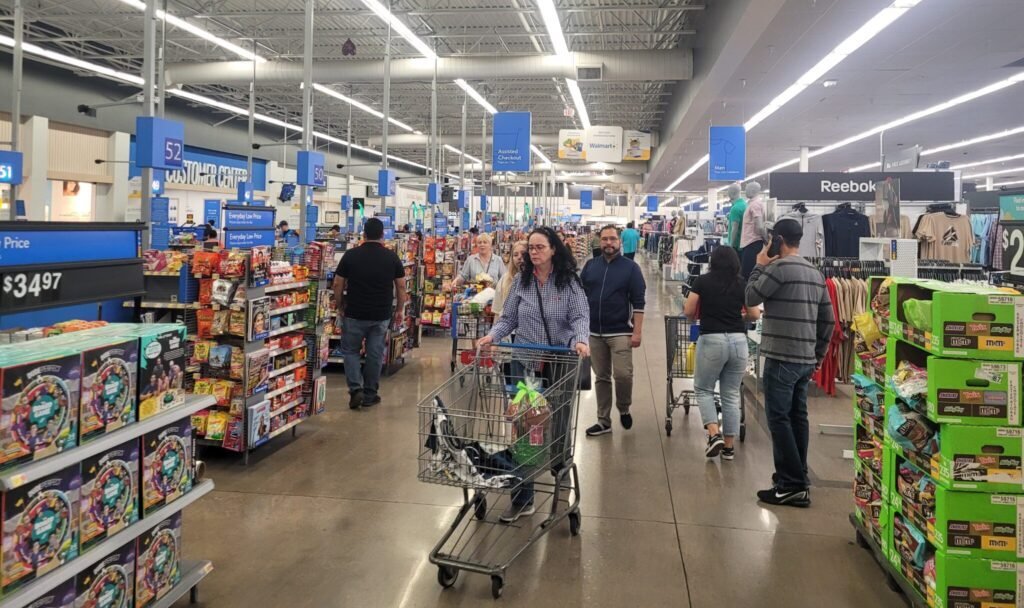
Data shows that Nebraska has about 25,000 fewer people receiving grocery assistance through the SNAP program since last July. Shown here are grocery shoppers at a Walmart store in Ohio. (Photo by Marty Schladen/Ohio Capital Journal)
By Cindy Gonzalez, Nebraska Examiner
(July 23, 2026)
The number of Nebraskans receiving public food aid has declined nearly 17%, or by about 25,000 people, since last July when Congress approved a massive 2025 tax and spending cuts package, according to newly released data from the Nebraska Department of Health and Human Services.
May through June marked the sharpest single month participation drop — nearly 6,000 — since at least 2014, says watchdog group Nebraska Appleseed. That’s when DHHS started sharing performance metrics on the Supplemental Nutrition Assistance Program formerly known as food stamps.
Groups that advocate for low-income families call the slide in SNAP participation alarming. They tie it not only to the act President Donald Trump calls big and beautiful, but also to what they view as stepped up state verification tactics that make applying more difficult.
“While that is happening we haven’t seen economic conditions improve, but we have seen grocery prices and inflation go up,” said Eric Savaiano, Appleseed’s manager for food and nutrition access.
He said he sees more stress on Nebraska families, emergency food systems and communities.
Angie Lauritsen, director of Nebraska For Us, a nonprofit formed to monitor economic issues and federal legislation, said that “making matters more challenging” are longer SNAP application processes.
The recent data, for example, shows that Nebraska’s average time to process an expedited SNAP application was more than five days in June, compared to just over three days in May and nearly three days in April. The state goal is three days or less, whereas the federal standard is seven days.
The report also showed that total calls to customer service centers handling SNAP and other state economic assistance benefits jumped beyond 80,000 in June, compared to about 61,000 the month before. Wait time went up from about 13 minutes a call in May to almost 23 minutes in June.
“Roadblocks and cuts are happening by design,” said Lauritsen.
She noted that all the Nebraska congressional delegation voted for Trump’s tax and spending measure.
ASK YOUR NEIGHBOR?
The latest DHHS report shows Nebraska SNAP enrollment at 124,299 individuals, down from nearly 150,000 last July. Officials and advocates had anticipated that eligibility changes and stricter work requirements in the new tax and spending law would reduce the number of refugees, veterans, homeless and people recently aged out of foster care who receive public food assistance.
Supporters of more stringent restrictions argue that the changes will increase accountability, self-sufficiency and help cut government spending.
DHHS also has noted that Nebraska is mandated to enforce changes in the food assistance program funded by the federal government. The Department of Agriculture covers the cost of benefits. States administer the program and share those costs with the feds.
In a statement Thursday, DHHS spokesman Jeff Powell said the agency is closely monitoring participation trends and their impact while also ensuring compliance with the federal law.
But Savaiano says Nebraska DHHS workers more recently started asking for more detailed financial and medical information that he believes has led to unnecessary burdens and loss of food assistance to qualified Nebraskans.
He said, for example, that some new and renewing SNAP applicants have had to get signed confirmation from a neighbor about who eats in their household.
“The state is now requiring verification for absolutely everything,” Savaiano said.
“It’s making it harder and harder for people to apply and receive SNAP.”
IN A TENT, UNDER A BRIDGE
Savaiano applauded Nebraska for keeping its payment error rate below 6% — one of only nine states to do so, which keeps them from having to pay for a bigger portion of SNAP benefits it pays out, starting next October. The federal government has fully paid for those benefits, but that is changing with Trump’s tax and spending bill.
But he said the effort to hold down the error rate shouldn’t come at the expense of Nebraskans qualified to receive grocery assistance.
The DHHS statement, while not addressing specific techniques, said SNAP recipients are able to verify eligibility through a variety of options. Powell said the agency has implemented verification options permitted under federal Food and Nutrition Administration guidelines.
“These verification practices were developed using approaches that have been successfully implemented in other states and are designed to ensure eligibility determinations are accurate while complying with federal requirements,” said Powell’s statement.
Of SNAP application times, he said applications increase substantially during summer months and that the state is “working aggressively” to address the workload while keeping “benefit accuracy” a top priority.
“DHHS is committed to ensuring the correct benefits are distributed to those eligible, payment errors are minimized and any new potential financial penalties are avoided,” Powell said.
Malissa Lang and her husband Dillion Taylor are among Nebraskans who said their SNAP benefits have been cut. Lang, who said she has been without the aid for six months, was among a group of homeless people who met in Lincoln on Thursday with Savaiano.
Lang, 37, said she’d been receiving public food assistance as she cared for her husband, who she said has been mostly deaf since childhood. The couple lives in a tent under a bridge. She said the state wants an updated diagnosis but her husband has had a lengthy wait to get proper medical checks and documentation.
Meanwhile, she said, the state required her to work and she said it was too tough to leave her husband alone, with his disability. She said they now get their food at pantries or dumpsters.
“They gave me time to fix it, we just couldn’t get the documentation,” Lang said. “We’re trying, and waiting.”