As back-to-school shopping begins, Nebraska educators and families worry about costs
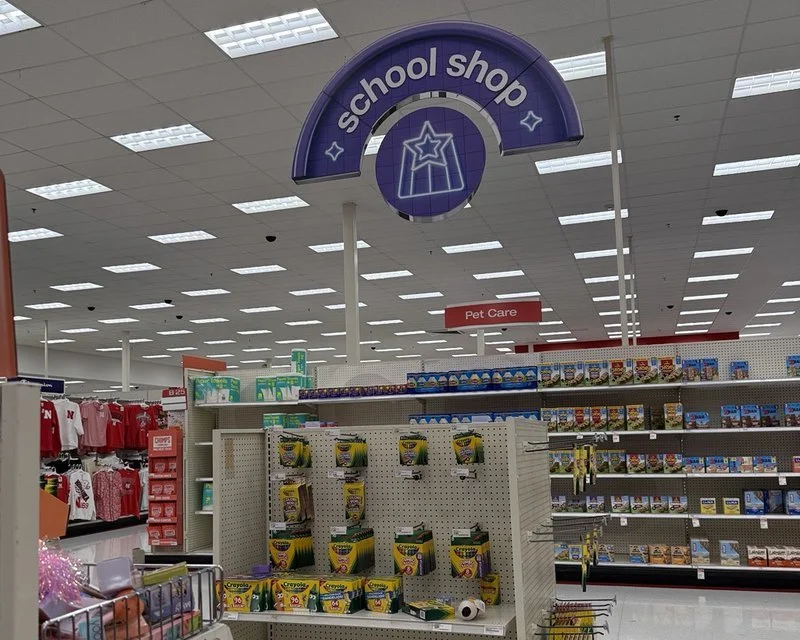
The "School Shop" in Target has a variety of school supplies, from crayons and markers to notebooks and pens. (Jolie Peal/Nebraska Public Media News)
By Jolie Peal, Nebraska Public Media
(August 3, 2026)
As Nebraska families and teachers prepare for students to head back to school, affordability is one of the main topics crossing their minds.
About 40% of parents expect to be more financially stressed with back-to-school shopping this year, and about 30% expect to use installment payments, credit or savings to cover the costs, according to a recent survey that polled U.S. consumers.
Angie Lauritsen, state director for Nebraska For Us, said that stress doesn’t stop at school supplies.
“When we're talking about food affordability, when we're talking about gas, when we're talking about the different supplies that we need in order to keep our households going, this also equates over to getting our kiddos ready to go back to school,” Lauritsen said.
The Midwest has long been seen as an affordable safe haven. And while more people are moving to the Midwest to seek more affordable housing and living expenses, recent reporting by the Midwest Newsroom has found that Nebraska isn’t benefitting from domestic migration. In a recent survey conducted by the Midwest Newsroom, dozens of respondents said housing and living expenses are crushing their bottom lines.
Lauritsen also shared concerns about the decline in the number of households in the Supplemental Nutrition Assistance Program, better known as SNAP. She worries about what that will mean for children receiving free and reduced lunch. Currently, students on SNAP automatically qualify for free and reduced lunch. Those families can fill out a form to still receive those resources, but Lauritsen said she’s worried parents may not want to admit they need help.
“I was a kiddo that grew up food insecure,” Lauritsen said. “I was a kiddo that at school, I knew I was going to be able to have a meal. That's not a certainty for so many of the kiddos in our communities right now.”
According to The Century Foundation, a progressive think tank, school lunches will cost families nearly 11% more this year.
Wes Jensen, vice president of advocacy for the Omaha Education Association and a teacher for 18 years, said those challenges at home, like not having enough food, will follow a student to school.
“When you talk with them, you realize, well, there wasn't much to eat the night before, and you can certainly tell how that affects their mood,” Jensen said. “If those basic needs aren't being met, it's really hard for us as a teacher — whether it's food, housing, healthcare — how are they going to be able to move forward academically when their basic needs aren't even being met?”
(Jolie Peal/Nebraska Public Media News)
Educators are feeling that strain, too. Jensen said while he has a great network of people helping fund his classroom supplies, he’s wondering if the higher costs of living will translate to less support throughout the year.
“Sometimes it comes to the end of the year where you need some Kleenexes or maybe you want to use the soft Kleenexes versus the school ones, and I'll be intrigued as I push that out with where the economy is,” Jensen said. “I've always been blessed with how my network supports me, but it'll be interesting to see if that does waver just with how expensive everything is.”
Tim Royers, Nebraska State Education Association president, said teachers, especially elementary school teachers, will put hundreds, sometimes thousands of dollars into their classroom.
“You've got to fill that up so that way there's life, and it's an inviting and welcoming place,” Royers said. “It's particularly challenging in your first year because you don't have paychecks in the summer to use. You don't get your first paycheck until September. That's a big challenge, and it adds to that barrier when we talk about the challenges of recruiting and retaining educators.”
It’s the time of year where teachers start putting up Amazon wish lists on social media, Royers said. He also pointed to local school foundations as another way to support teachers as they prepare for back-to-school.
La Vista Gives, a partnership between the city of La Vista and the La Vista Community Foundation, has held a school supply drive for 13 years. Mitch Beaumont, communications and marketing manager for the city of La Vista, said donations are down this year, partly because of some corporate partners not being able to host a drive this year, but also because of costs.
“This will be a guess, but for the same reasons that there is a need for these donations, probably is the same reason that donations are down, and that being life is expensive, right?” Beaumont said. “The people who are giving are also families, and they have to provide for their people, too.”

(Jolie Peal/Nebraska Public Media News)
Beaumont said this year’s drive is focused on two elementary schools — La Vista West and Parkview Heights. It rotates each year through four elementary schools that show interest in receiving supplies.
They typically end up with one to two pickup truck loads of supplies to take to each school.
“The school staff are touched,” Beaumont said. “I think they see the need in the kids certainly much deeper than we do. They know what donations of fairly normal school supplies mean to some of these families. They know that their students will have what they need to be successful in the school year.”
Jensen said people can also support teachers through the simple act of sending a kind note.
“I always say when you support a teacher, you're supporting a kid. When you support kids, you're supporting their families, and it's all interconnected,” Jensen said. “I think Nebraska is great, where we truly do support our schools.”